.svg)
If you are upgrading from version 23.241 or earlier use the following upgrade notes.
If you are running FileCloud in a high availability environment, to upgrade to the latest version, please Contact FileCloud Support.
FileCloud Support can help you upgrade or can provide a PDF with instructions if you would like to perform the upgrade without assistance.
Pre-upgrade
-
As always, make a full backup of your existing installation before upgrading.
Backup FileCloud on Windows -
Please check all of the following conditions and see if any apply to the version you are updating from. For any that apply to you, take the specified step.
-
If you are running FileCloud in a high availability or multi-server environment, verify that the MongoDB feature compatibility version is set to version 6. If not, set MongoDB feature compatibility to version 6 by following the instructions at https://www.mongodb.com/docs/manual/reference/command/setFeatureCompatibilityVersion/ or contacting FileCloud support.
-
If your FileCloud installation uses admin portal user access restrictions, follow the steps at Restricting Access To Admin UI Based On IP Addresses.
-
If you are running a version of FileCloud below 23.1 and you have folder-level security enabled in Settings > Misc > General, changes in functionality will significantly impact the way existing share behavior works when you upgrade.
Please contact FileCloud Support before upgrading to avoid share and file access issues. -
If your system uses WebDAV, please contact FileCloud Support before upgrading.
Upgrading from a version prior to 23.241 to the current version completely disables WebDAV functionality. -
If your SSL certificate key is less than 2048 bits in length, generate a new SSL certificate key of at least 2048 bits. For information, please Contact FileCloud Support (note that FileCloud support does not provide or generate certificates for customers).
-
If you have enabled managed store encryption, and you have not yet changed your encryption from RC4, which has been deprecated, to AES256:
Follow the steps below this list under Windows: Upgrading Versions <23.242 to the Latest Version | Instructions for systems with managed storage encryption enabled.
-
If you are not running Windows Server 2019 or Windows Server 2022, migrate your FileCloud site to one of these versions .
-
If your Solr data with indexes was created using Solr version 7.x or older, please do a full re-index.The version of Solr has been upgraded in FileCloud 23.232.
-
If your system uses MongoDB authentication or custom IP binding, follow the steps below this list at Windows: Upgrading Versions <23.242 to the Latest Version | If you are upgrading to the latest FileCloud version and you are using a custom mongodb.conf [inlineExtension] .
-
If you use an AD attribute other than mail, follow the steps below this list at Windows: Upgrading Versions <23.242 to the Latest Version | Correcting the AD mail attribute .
-
If you are using custom API services, follow these steps below this list atWindows: Upgrading Versions <23.242 to the Latest Version | If you are upgrading to the latest version and you are using custom API services.
-
If your system uses ServerLink, follow these steps below this list at Windows: Upgrading Versions <23.242 to the Latest Version | Upgrading systems that use ServerLink
-
If you are upgrading to the latest FileCloud version and you are using a custom mongodb.conf
If you are upgrading to the latest FileCloud version and you are using a custom mongodb.conf
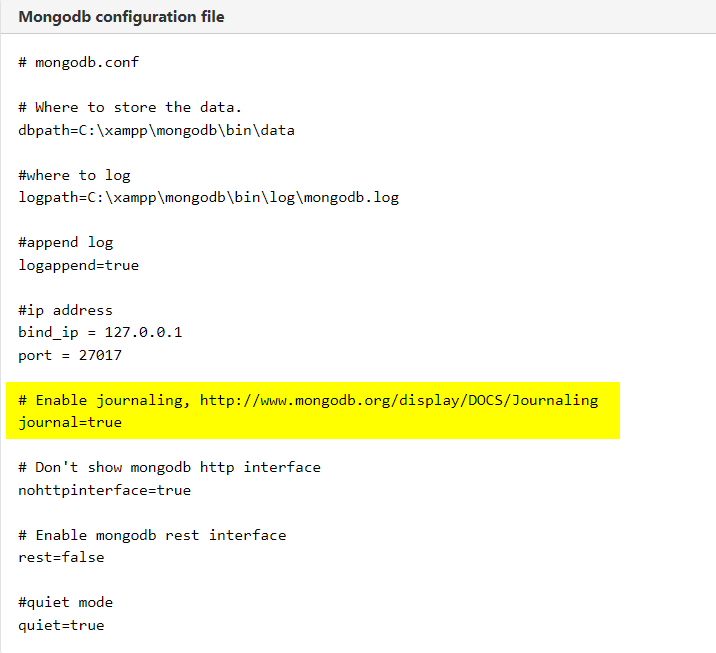
If you are running mongoDB as a service in Windows and updating from a version of FileCloud earlier than 23.242 to the latest version, and you are replacing the provided mongodb.conf with a custom one, it is important that you remove the journal=true setting which is no longer supported.
To remove the command:
-
Open C:\\xampp\mongodb\mongodb.conf.
-
Delete the lines that are highlighted in the image below and save the file.
Upgrade instructions
-
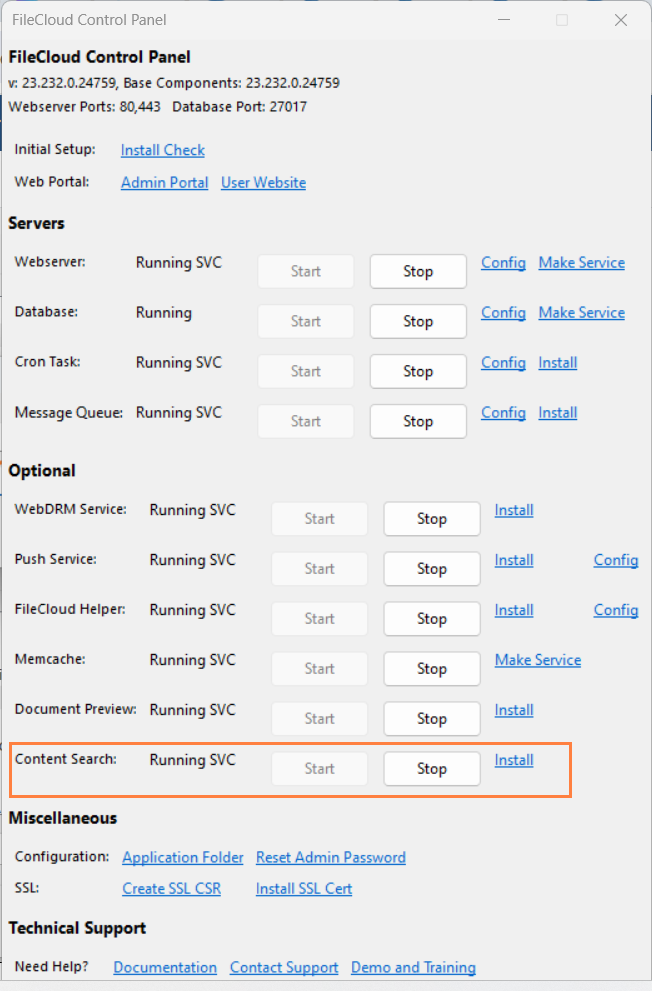
When you are upgrading to the latest version, leave all FileCloud services in the control panel running.
-
If you are upgrading from FileCloud 23.241, in addition to confirming that each of your FileCloud services is running, make sure that your storage is in a READY state.
-
Use the upgrade tool to do a full upgrade.
Upgrade using Update Tool (Windows Only) -
For all upgrades, once upgrade is complete, refresh the browser using CTRL-F5 to clear any prior setup information from the cache.
Post Upgrade
-
If you are running in a high availability or multi-server environment manually set the MongoDB feature compatibility version to version 7. Use the instructions at https://www.mongodb.com/docs/manual/reference/command/setFeatureCompatibilityVersion/ or contact FileCloud support.
-
Beginning with version 23.252, a new group, Externals, automatically includes all External users, and the Everyone group does not include External users. External users who were include in the Everyone group in earlier versions of FileCloud are no longer included in it.
The Externals group functions to prevent External users from having the same share, folder, and policy access as users in the Everyone group.
Previously created DLP rules that denied access to the Everyone group will now deny access to both the Everyone and Externals groups. Previously created DLP rules that allowed access to the Everyone group will continue to allow access to the Everyone group and not to the Externals group.
If your use cases require that external users have the same access to files and folders as other users, you can give the Externals group the same permissions as the Everyone group by running the tool assignexternalsgroup.php. See Assign the Externals Group the Same File Access as the Everyone Group for help.
-
Beginning in FileCloud 23.253, by default, a more granular dynamic content security policy replaces the existing content security policy in the .htaccess file. If you are upgrading, to make this change effective, you must make a small change to the Content-Security-Policy header in the .htaccess file:
-
Open the .htaccess file.
C:\xampp\htdocs\.htaccess -
Find the line that begins:
Header set Content-Security-Policy: -
Change set to setifempty:
Header setifempty Content-Security-Policy: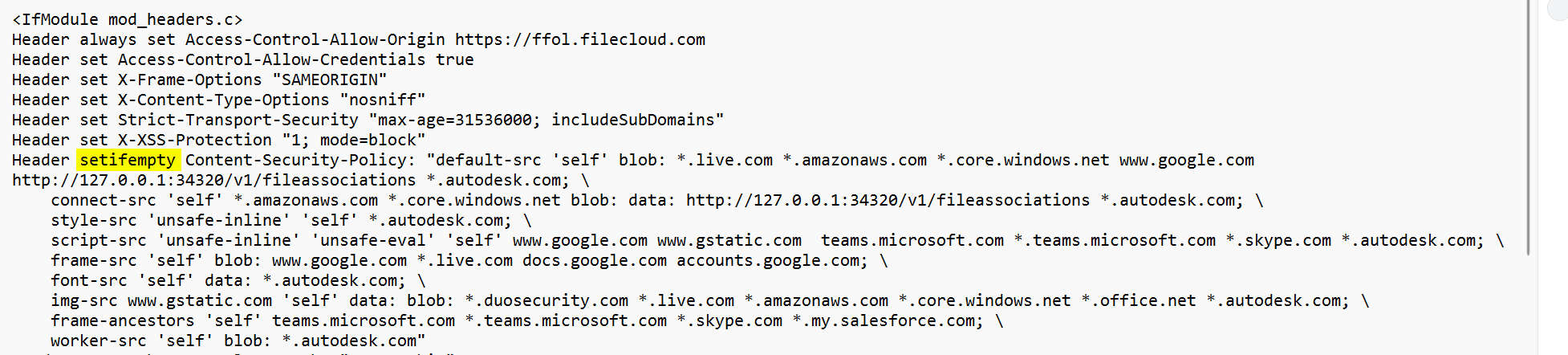
-
-
If you plan to update to the new FileCloud Outlook Add-in, see Windows: Upgrading Versions <23.242 to the Latest Version | Upgrade instructions for the FileCloud 23.242 Outlook Add in .
-
If you are upgrading FileCloud from a version below 23.241 and your system uses SSO, follow the instructions below in Windows: Upgrading Versions <23.242 to the Latest Version | Configuring SSO after updating from a version older than 23.241
This is necessary because Version 23.241.x of FileCloud dropped support for Shibboleth 1.3 and SAML 1.1, and updated SimpleSAML to version 2.x. -
If you are upgrading from a version prior to 23.1 and upgrading to a system running with MongoDB replica set or standalone MongoDB, follow the steps in Windows: Upgrading Versions <23.242 to the Latest Version | FC Push Service Configuration
-
If you are using Solr, follow the steps below under https://fileclouddocs.atlassian.net/wiki/spaces/FH/pages/edit-v2/114556973#Upgrade-Windows-environments-using-Solr-and-Solr%2BOCR .
-
After you upgrade to FileCloud 23.261, to use FileCloud, iOS mobile users must upgrade to iOS 16+ and FileCloud 23.261.
Upgrade Windows environments using Solr and Solr+OCR
Upgrade Windows environments using Solr and Solr+OCR
-
Upgrade FileCloud
-
Set JAVA_HOME to the new version's path.
-
Log in to the FileCloud admin portal.
-
In the FileCloud Control Panel, and stop and restart Content Search.