.svg)
Administrators can import files to managed storage configuration to prepare FileCloud for users.
NOTES:
-
During the seeding operation, the system is operating under a special mode and user access must not be allowed (though it is not prevented automatically).
-
Therefore, ideally, seeding should be done during initial system setup.
-
Once seeding is done, indexing must be done manually.
Import Files into Local Managed Storage
Prerequisite:
In order for the data to be imported, the following conditions must be met.
-
The data must be in locally accessible disk. Ideally, the data must reside in the same drive as the managed storage (for example, if managed storage is in C:\fileclouddata, then the import data must also be in C: drive)
-
The data must be in following structure. <ImportPath><users><data>. For example, if you have four users, bshepard, jsmith, mjackson, sjane, then the structure should be:

-
The users must already be created in the system (bshepard, jsmith, mjackson, sjane must already be valid full users in the system).
-
The users must have enough quota assigned to allow the data import.
To import files into local managed storage:
-
In the FileCloud admin portal's left navigation bar, scroll down and click Settings. Then, on the Settings navigation page, click Misc Unknown Attachment .
By default, General settings are opened. -
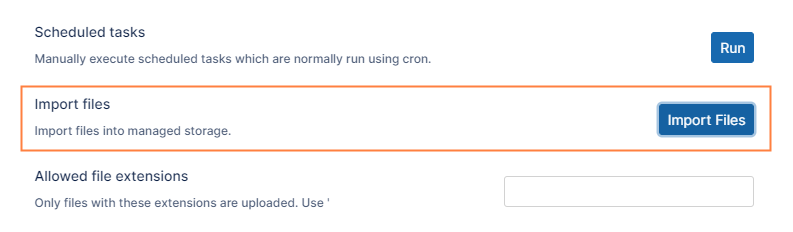
Scroll down to Import Files, and click the Import Files button.
-
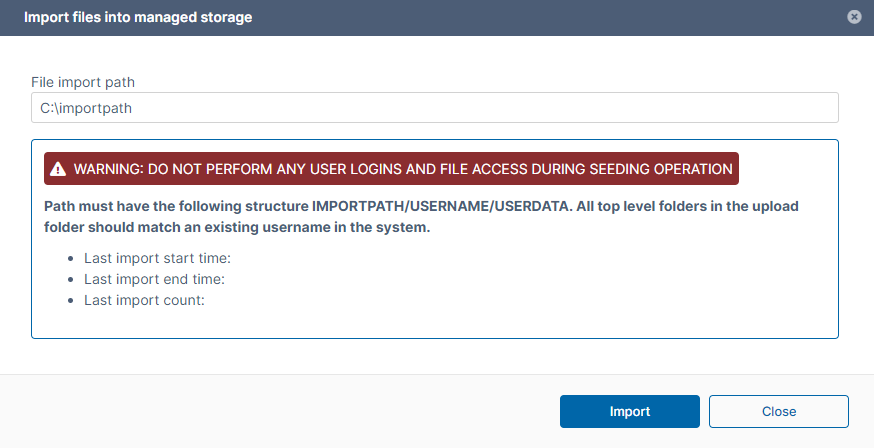
On the Import files into managed storage dialog box, in File Import Path, type the location to the files you want to import in the format C:\importpath or \import\data.
-
Click Import.
Import files into S3 Managed Storage
Prerequisite:
In order for the data to be imported, the following conditions must be met
-
The data must be in a bucket that is accessible with the same credentials as the Managed Storage bucket
-
Both Managed Storage as well as the seeding bucket should not have encryption enabled.
-
The data must be in following structure. <Toplevel Folder><List of valid user account folders><data for each of the folder>
-
The users must already be created in the system with full user status.
-
The users must have enough quota assigned to allow the data import.
To import files into S3 managed storage:
-
In the FileCloud admin portal's left navigation bar, scroll down and click Settings. Then, on the Settings navigation page, click Misc Unknown Attachment .
By default, General settings are opened. -
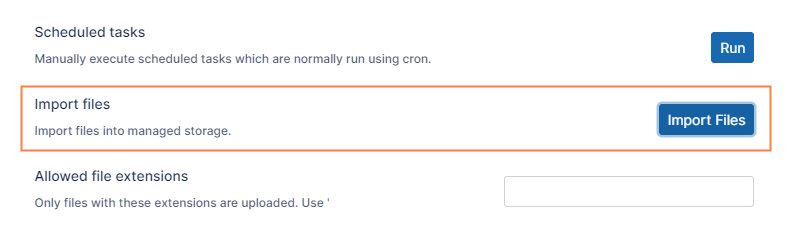
Scroll down to Import Files, and click the Import Files button.
-
On the Import files into managed storage dialog box, fille in the fields as follows:
File import path - The originating folder of the content to be imported.
Bucket - the name of the bucket that contains the files you want to import.
S3 folder name - the name of the top level folder in the bucket that contains the files you want to import.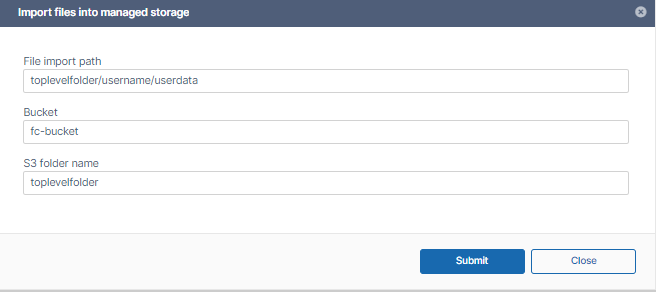
-
Click Submit.
Import Files into S3 Managed Storage
Prerequisite:
In order for the data to be imported, the following conditions must be met
-
The data must be in a bucket that is accessible with the same credentials as the Managed Storage bucket
-
Both Managed Storage as well as the seeding bucket should not have encryption enabled.
-
The data must be in following structure. <Toplevel Folder><List of valid user account folders><data for each of the folder>
-
The users must already be created in the system with full user status.
-
The users must have enough quota assigned to allow the data import.
To import files into S3 managed storage:
-
In the FileCloud admin portal's left navigation bar, scroll down and click Settings. Then, on the Settings navigation page, click Misc Unknown Attachment .
By default, General settings are opened. -
Scroll down to Import Files, and click the Import Files button.
-
On the Import files into managed storage dialog box, fille in the fields as follows:
File import path - The originating folder of the content to be imported.
Bucket - the name of the bucket that contains the files you want to import.
S3 folder name - the name of the top level folder in the bucket that contains the files you want to import.
-
Click Submit.